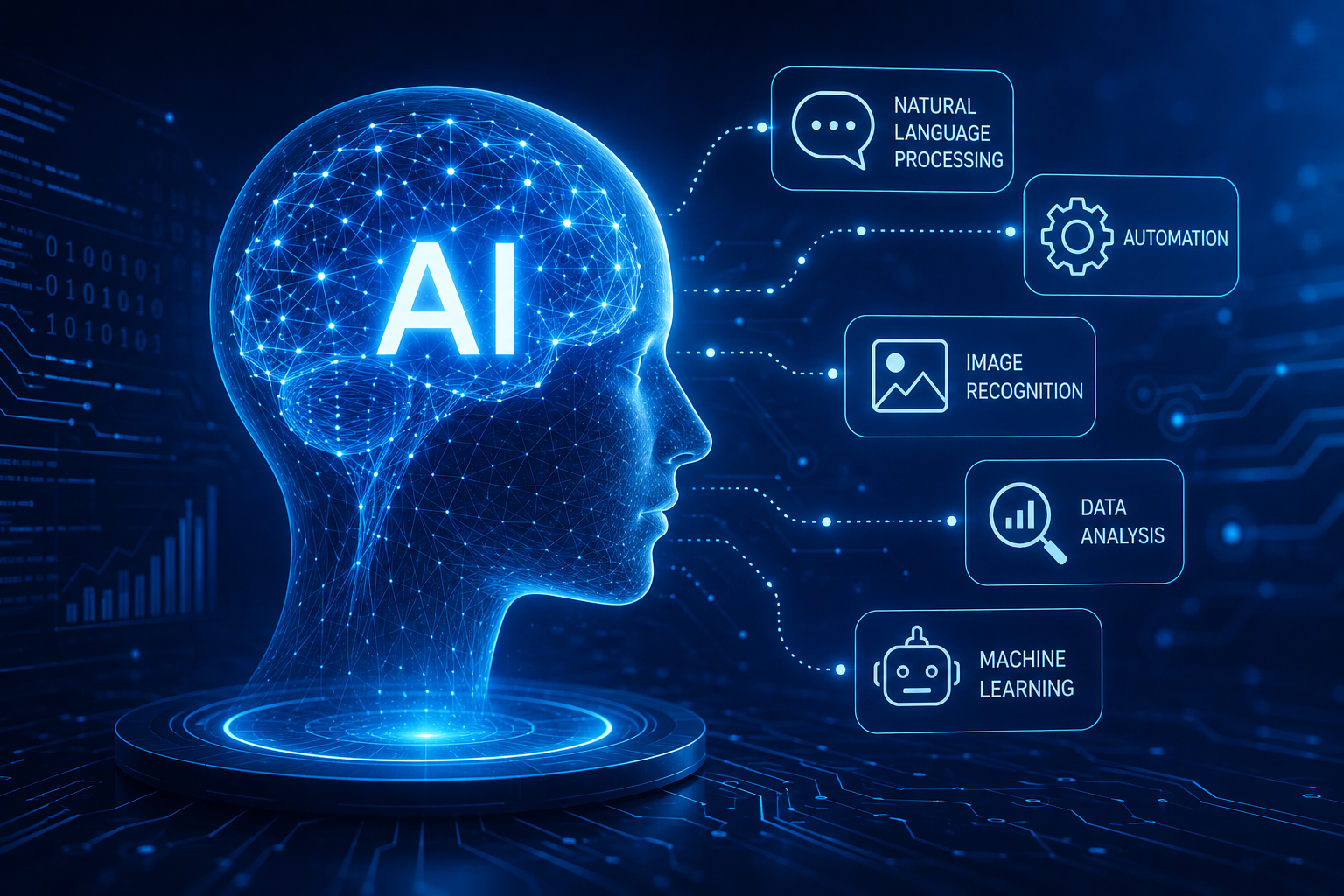
Artificial Intelligence (AI) is one of the hottest topics these days. AI is transforming lives and livelihoods, from voice assistants and chatbots to self-driving cars and personalized recommendations. From all the way to businesses, schools, hospitals, and even governments, AI is being used to boost efficiency, automate processes, and make better decisions.
This guide answers the question: What is Artificial Intelligence (AI)? – in simple terms, how it works, why it is important, and how it is used in our daily lives.
What is Artificial Intelligence (AI)?
Artificial Intelligence (AI) is a subfield of computer science that focuses on making machines and software act in ways that are typically done by humans using their intelligence. These include learning from data, speech recognition, language understanding, problem solving, decision making, and pattern recognition.
AI systems can process information and learn from their experiences, while also adapting to changing circumstances and improving their performance over time, unlike traditional computer programs, which can only be executed on fixed instructions. AI’s flexibility and competence in complex tasks are enhanced by this capability.
AI is at work, for instance, when you request a virtual assistant to set an alarm, get movie recommendations from a movie streaming service, or unlock your smartphone using facial recognition.
Why Is Artificial Intelligence Important?
AI is essential because it supports people and businesses to accomplish tasks in a more precise and efficient manner. AI automates repetitive tasks, processes vast data, enhances customer service, and facilitates quicker decision-making in businesses.
AI helps diagnose diseases, detect fraud in financial systems, and make product suggestions to retailers based on customer preferences.
With the advancement of technology, AI is now being used in almost all industries.
How Does Artificial Intelligence Work?
AI operates on vast amounts of data that is gathered and analyzed. It employs algorithms that find patterns and relationships in this data. Drawing on past experience, AI systems can predict, categorize, or execute certain actions without having to be programmed for every case.
Most AI functions use machine learning, which enables the machine to grow more precise with the more data that it utilizes. The use of deep learning, which mimics the structure of the human brain to tackle more complex issues like image recognition and natural language understanding, is also employed in some advanced AI systems.
What is the use of Artificial Intelligence?
Artificial Intelligence has become part and parcel of everyday life, even though many are not aware of it.
Artificial Intelligence is utilized in smartphones for voice recognition, camera enhancement, and predictive text. AI powers search engine functionality, enabling them to provide relevant search results. Online shopping sites show products that have been viewed by the user, and streaming sites suggest movies and music according to the users’ tastes.
In the healthcare sector, AI is employed to analyze medical images; in banking, it is utilized for fraud detection; in transportation, for navigation systems; and in education, for personalized learning experiences.
Where Is Artificial Intelligence Used?
Generally, there are different categories of Artificial Intelligence in accordance with the capabilities.
Narrow AI, or Weak AI, focuses on a singular task like translation, recommendation systems, and virtual assistants. This is the kind of AI that is found in most applications currently.
General AI is a theoretical form of intelligence that would be capable of performing any intellectual task that a human can do. While it’s still being researched, General AI has not been attained.
There is also talk about a future development called Super AI, where the superintelligence of the machine will be greater than the intelligence of a human in all areas. It’s still a theoretical idea at this time, and it does not yet exist.
The difference between AI and Machine Learning?
Artificial Intelligence and Machine Learning are different concepts, and many people wrongly consider them as identical.
Artificial Intelligence is a larger term used to describe the field of creating intelligent systems that can do things like humans.
Machine Learning is a branch of AI that allows computers to learn from data and make improvements without having to be explicitly programmed for every task.
Artificial Intelligence is one of the technologies made possible by machine learning—it’s a simple explanation.
What’s the Positive Impact of AI?
There are numerous benefits of AI for businesses and individuals alike.
It improves productivity by eliminating repetitive tasks, decreases human error, handles large volumes of data rapidly, and aids organizations in making data-informed decisions. AI also enhances customer experiences with recommendations, intelligent chatbots, and quicker support.
AI helps physicians in the medical field with diagnosis and treatment. It can be used to improve production processes in manufacturing, to enhance fraud detection and risk management in finance, and in other fields.
What are the problems with AI?
While AI has numerous advantages, it also poses certain difficulties.
One of the concerns is privacy, as AI systems typically need extensive user data. Ethical concerns include biases in AI algorithms, transparency in decision-making processes, and responsible technology usage.
Many jobs could be fundamentally impacted by automation, necessitating the transformation of job roles and the acquisition of new skills. Furthermore, the accuracy and reliability of AI systems are significantly reliant on the quality and integrity of the data they rely on to train themselves. Additionally, the accuracy and reliability of AI systems are heavily dependent on the quality and reliability of the data they are based upon to train themselves.
What Can Be the First Step Towards Learning Artificial Intelligence?
There is no need to have an in-depth understanding of technical aspects to learn Artificial Intelligence. Students new to programming should begin by learning some programming basics, statistics, math, and machine learning basics.
The most popular language for AI is Python, as it has robust libraries for data analysis, machine learning, and deep learning. Building AI skills through hands-on projects and real-world data experimentation is one of the best ways to develop AI skills.
Additionally, a myriad of online courses, tutorials, and open-source tools are helping to make the study of AI more accessible than ever before.
Where is Artificial Intelligence going?
The future promises bright prospects for the development of AI, with organizations investing in automation and intelligent technologies. AI is anticipated to have a more significant impact in the following industries: medical research, education, transportation, cybersecurity, science and research, and business.
AI is not about replacing humans altogether, but more about assisting them with tasks that are repetitive and analysis that can help them make informed decisions.
With the ongoing advancement of AI technology, it will bring forth new opportunities and demands for responsible innovation and responsible ethics.
Conclusion
Artificial Intelligence (AI) is changing the world of today by helping machines to learn, solve problems, and make intelligent decisions. AI is already enhancing various aspects of everyday life, from making smartphones more intelligent to making online shopping more convenient, and from revolutionizing healthcare to transforming finance. By gaining an understanding of the workings, applications, and advantages and disadvantages of AI, individuals and businesses can better prepare for a future with even more intelligent technology.
Frequently Asked Questions
How does Artificial Intelligence work?
The key underlying principle of the workings of AI is the ability to process vast amounts of data, detect patterns, and generate predictions or decisions through the use of algorithms. Many AI systems get better as they gain knowledge through machine learning.
What is the difference between Artificial Intelligence and Machine Learning?
No. Artificial Intelligence is a wider concept, and Machine Learning is a part of AI where computers can learn from data.
What are the applications of Artificial Intelligence?
AI is present in medicine, education, financial transactions, the e-commerce sector, transportation, customer service, industry, entertainment, and many other areas.
But is Artificial Intelligence good for business?
Yes. AI can streamline operations, boost productivity, interpret data, enrich the customer journey, and optimize decision-making for businesses.
Is Artificial Intelligence (AI) something that can be learned by beginners?
Yes. To get started, beginners should begin to learn Python, get a grasp of the basics in Math and Statistics, and familiarize themselves with the concepts of Machine learning before working on an AI project.