Artificial Intelligence (AI) is changing the way people work, communicate and interact with technology. AI has become a key component in today’s life, from virtual assistants and smart devices to automated business operations and content creation. The knowledge of the workings of AI is becoming increasingly useful, as businesses and individuals continue to embrace intelligent technologies.
So, what exactly is AI? Is it intelligent or does it just obey? The solution lies in data, algorithms, machine learning, and sophisticated computing systems that enable machines to detect patterns and produce valuable outputs.
This article covers the basics of AI Work, how it works, the primary categories and the core disciplines of AI in simple terms.
What is Artificial Intelligence and how does it work?
AI is a type of computer science that deals with creating AI Work systems that execute tasks usually handled by human intelligence. These tasks involve language comprehension, recognition of images, information analysis, problem solving, and prediction.
Algorithms and computational models are used to analyze information and find patterns in large datasets in AI systems. They can be implemented to carry out specific functions, learn from examples, or produce new content based on the examples they observe.
For instance, if you ask a virtual assistant a question, the system analyzes the question, understands its content and generates a response based on its training and knowledge.
AI is applied in various sectors, such as healthcare, education, finance, retail, manufacturing, and digital marketing.
How Does AI Work? Understanding the Process
Generally, AI systems follow a process of data collection, data processing, pattern recognition, and output generation. These models can be further refined by training and feedback.
The basic AI working process is explained below.
1. Input: Collecting Data
The first step is to gather information from various sources. AI systems require data to recognize patterns and perform tasks.
Data can include:
- Text documents and written information.
- Images and videos.
- Audio recording and speech.
- Data and business statistics.
The accuracy and significance of information are pivotal to the success of an AI system.
2. Processing: Analyzing Information
Data is gathered and then manipulated by algorithms and trained models of the AI systems.
These models process data and can detect patterns that would not be noticed by human eyes and brains. For instance, an AI system that is trained on customer purchase histories can determine common shopping behavior.
Processing enables AI to interpret the inputs and identify the relevant information for a specific purpose.
3. Outcomes: Generating Results
After processing the information, the AI system generates an output.
The output can be a prediction, classification, recommendation, generated response or an automatic action, depending on the task.
For instance, AI can:
- Predict customer demand.
- Identify spam emails.
- Recommend products.
- Generate written content.
- Identify objects in pictures.
This varies according to model, data, and purpose for which it was designed.
4. Adjustments: Learning From Feedback
Certain AI systems may be trained and fed with data to enhance their capabilities.Some AI systems may be trained and fed with data to improve their capabilities.
In the training process of machine learning, the results of the machine are compared with the expected results. The system fine-tunes itself to minimise errors.
The process is continued until the model has performed to a satisfactory level.
Not all AI systems are continually learning after deployment, though. Many of these models are not meant to be altered after they are trained.
5. Assessment: Evaluating Performance
The last one is to assess the precision and reliability of an AI system.
Different evaluation methods are used by the developers to decide if the model is useful.
Common assessment factors include:
- Accuracy and reliability.
- Processing speed.
- The quality of the content created.
- Capacity to deal with new information.
- Risk of bias and error.
Assessment is necessary to identify limitations and enhance AI systems in important applications before use.
The Four Main Types of AI
Generally, AI is categorized into four different types based on the type of capabilities and theoretical development.
Reactive Machines
Reactive machines are AI Work that can “react” to the input that is in front of them at the time, but have no memory of past experiences.
They are devised to handle particular tasks and do not learn from previous interactions.
Limited Memory AI
Limited memory systems rely on past observations or data to make decisions.
Limited memory approaches are employed by many modern AI applications such as some autonomous driving systems and machine learning models.
Theory of Mind AI
Theory of mind AI is a theoretical concept that would enable the understanding of the mental state, intention and emotions of other entities.
While AI can pick up on some emotional cues and react to social cues in certain ways, human-like theory of mind is still a work in progress.
Self-Aware AI
Self-aware AI is a theoretical type of AI that would have an awareness of its own existence.
These are not yet available as a well-established AI technology.
Major Disciplines That Make Up AI
There are several specialised areas of AI that are combined to produce intelligent systems.
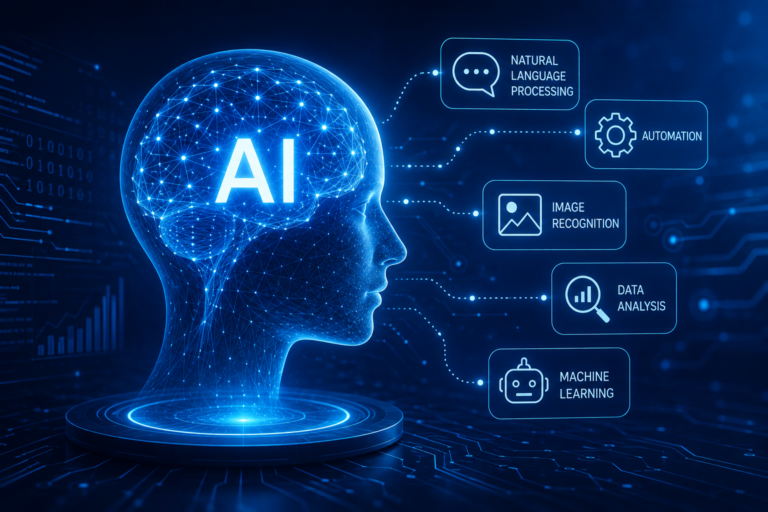
Machine Learning
Machine learning is a branch of AI that enables a machine to learn from the patterns in the data and to predict future trends without having to be told exactly what to do.
It’s heavily employed in recommendation systems, in fraud detection and in predictive analytics.
Deep Learning
Deep learning is one of the subfields of machine learning, which relies on multi-layered neural networks to process complicated information.
It has a significant impact on image recognition, speech processing, and generative AI.
Neural Networks
Neural networks are computational models based on some aspects of the structure of the human brain.
They learn patterns by being trained and process information by having layers of connected units.
Natural Language Processing
Natural language processing (NLP) is the ability of computers to process and interpret human language.
It can be used in applications like chatbots, translation software, voice assistants, and text summarization tools.
Computer Vision
Computer vision enables AI systems to interpret images and videos.
It is applied to facial recognition, medical imaging, object detection and quality inspection.
How Generative AI Works
Generative AI: AI that produces new content from patterns it has learned during training.
Generative models can be used to create:
- Composing pieces of writing and summaries.
- Images and illustrations.
- Audio and music.
- Video and animations.
- Computer code.
One of the biggest areas of generative AI is large language models (LLMs). They are taught large amounts of text data and are taught a statistical correlation between words and other aspects of words and language.
The user types a question, and the model responds with a reply that it has learned from the context of the conversation and its patterns.
Generative AI can create amazing results but sometimes it can get information wrong or misinformation. Even when accuracy is critical, human reviewing will play a role.
Benefits of Artificial Intelligence
There are a number of advantages of using AI for individuals and organizations.
- Automation: Eliminates repetitive tasks and time.
- Productivity: Assists users to perform tasks more efficiently.
- Data analysis: Detects trends in large data sets.
- Personalization: Allows customised recommendations.
- Decision support: Supplies information to help people make decisions.
The advantages of AI make it an invaluable tool in streamlining processes and creating new services.
Conclusion
The first step in grasping the applications of AI Work is to get a grasp of the fundamental concepts, such as data, algorithms, machine learning, and neural networks. In these technologies, computers find patterns, make predictions, and carry out tasks that normally have to be done by a human.
AI is advancing in various sectors, from machine learning and computer vision to natural language processing and generative AI.
Comprehending its basics enables individuals and businesses to make well-informed choices regarding implementing AI Work tools, boosting productivity, and discovering new opportunities within the digital landscape.
With the rise of AI, it is essential to grasp its fundamentals for understanding the future of technology.