With the competitive business landscape, it is essential for companies to have efficient systems that keep them running smoothly, boost productivity and help them make informed decisions. Having different tools for each department can cause communication breakdown, data duplication and extra expenses. It is in this place that ERP software comes in handy. Enterprise Resource Planning (ERP) software can help to streamline your core business processes in one place, making things more organized and effective.
ERP solutions can help businesses of all sizes manage their resources more effectively, plan their finances, control their inventory, and provide better customer service. Reading about the workings and the value ERP software brings to the business growth is beneficial for companies in selecting the proper technology for their long-term objectives.
What are ERP Software Solutions?
ERP software is also known as Enterprise Resource Planning software. It is a system for a business that connects different aspects of the business on one platform. In the past, companies would have their own software programs for human resources, procurement, sales, inventory and accounting – but with ERP software these processes can be managed in a single place.
An ERP system will most likely have a common database system with up-to-date information accessible to authorized staff members. This helps the departments work together and eliminates the need to manually enter the data repeatedly.
There are available modern ERP solutions available, which can be cloud-based, on-premises, or hybrid. Cloud ERP is available from a service provider via the internet, while on-premises ERP is installed on the company’s own infrastructure. The selection of the right option will rely on business requirements, budget, security requirements, and technical resources.
What is ERP Software?
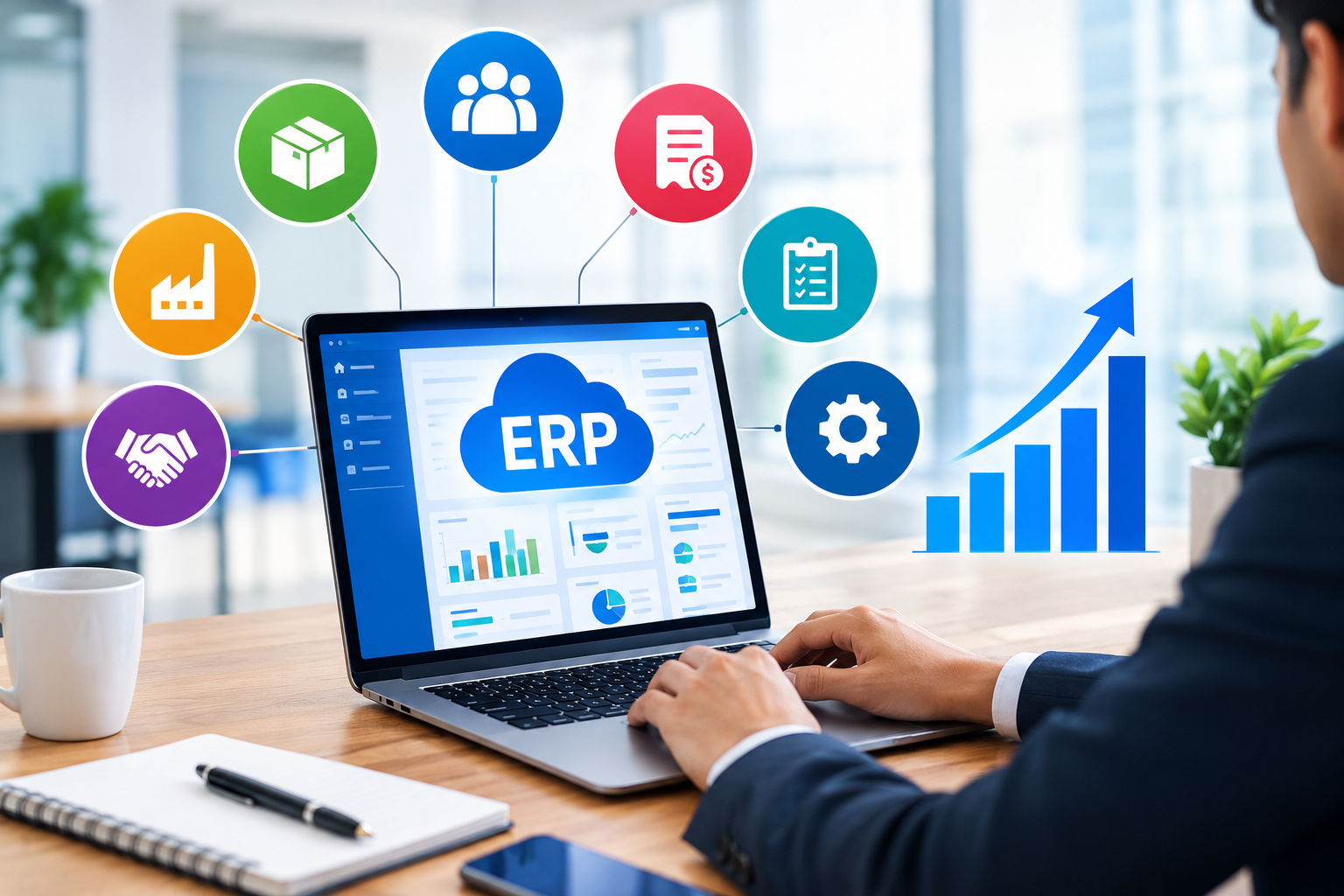
ERP software brings different departments of business together with the help of its integrated modules. All modules perform a particular function and communicate with others in the system.
When a sales team gets an order, for instance, the ERP system can automatically update inventory, produce the required financial data, and alert the warehouse team. It integrates workflow and therefore minimizes delays and ensures consistency of data for employees.
Common ERP modules include:
- Finance and accounting: Records costs, income, invoices, budgets, and financial statements.
- Inventory management: Keeps track of stock levels, product movement, and reordering needs.
- Human resources: Manages workers’ files, payroll, attendance and recruitment.
- Sales and Customer management: handles sales and customer information, customer order management, sales performance.
- Procurement: Assists in managing supplier relationships, purchase orders and purchasing.
- Production planning: Helps manufacturers plan production, materials, and track production.
Depending on the needs of a business, they can choose modules that best suit the business and gradually add more to their ERP as they grow.
Key Benefits of ERP Software for Business Growth
1. Improved Operational Efficiency
One of the main benefits of ERP software is its ability to automate repetitive business tasks. Manually processing invoices, updating inventory, monitoring orders, and generating reports are just a few of the activities that can be time-consuming.
ERP automation eliminates repetitive administrative tasks and enables workers to concentrate on more meaningful work. Standardized workflows also help in identifying bottlenecks and optimizing overall performance.
2. Improved Data Management and Data Accuracy
One of the challenges businesses face is having information scattered across spreadsheets, emails, and uncoordinated applications. When there are separate records, inconsistencies may occur and it is hard to see which of the records is the newest.
ERP software brings all the key business data together and minimizes data duplication. Employees can access consistent records, assisting management to make decisions based on more reliable information, with appropriate access permissions.
3. Stronger Financial Management
Clear cash flow is the key to growing businesses. ERP systems can track cash flow, manage expenses, track invoices and prepare financial reports.
Financial workflow automation can help cut down on calculation inaccuracies and enhance reporting times. This information can help managers to assess costs, analyze spending trends and better prepare budgets.
4. Effective Inventory and Supply Chain Management
The customer satisfaction as well as profitability can be affected due to the inventory problem. Too much stock means that working capital is tied up, too little stock and you will face delays and lost sales.
ERP systems offer inventory management solutions that give visibility into the stock levels, movements, and the need for purchasing. Combined with procurement and sales, these tools enable businesses to plan their stock, manage suppliers, and coordinate orders.
5. Enhanced Customer Satisfaction
Customers want the details of what they’ve ordered to be correct, and they want it delivered in a timely fashion and services to be available. ERP software allows teams to easily access information about the customer, sales, and inventory without having to manually ask other departments for information repeatedly.
This enhanced coordination can assist in quicker order processing, more effective delivery planning and uniform communication with customers. This allows businesses to build customer relationships and promote repeat sales.
What is ERP Software? and How ERP Software Supports Business Expansion?
When a company grows, its processes get more complicated. Existing systems could be challenged by increased customer, employee, supplier and transaction volume.
ERP software offers an organized platform for dealing with the complexity. Depending on the system capabilities and the licensing model, businesses can add other modules, users, or locations when needed to meet changing business requirements.
An ERP system, for instance, can be utilized at first by a retail business that is expanding and needs accounting and inventory management capabilities. It can also include advanced reporting, warehouse management, and purchasing in the future, for multiple locations.
The scalability allows companies to establish uniform processes while not having to replace their entire technology infrastructure.
The Role of ERP Analytics in Decision-Making
To grow a business, you need to know how well it is performing and act accordingly to suit the market. ERP systems can offer dashboards, reports, and performance measures to assist administration track crucial business activities.
This could involve such things as when sales are happening, how much they’re costing, how they’re turning over inventory, how much they’re producing, and the performance of order fulfillment.
Proper information will help managers to focus on weak spots, reallocate resources and recognize opportunities for improvement. Some ERP solutions are more advanced, and can include forecasting and AI-powered analysis—these features depend on the provider and the particular ERP product.
Choosing the Right ERP Software
There is a need for ERP system selection planning. What is successful in one organization might not be in another.
Businesses should take these factors into account before making their decision:
- Business needs: Determine what processes can be improved, and what the company truly requires.
- Costs: Assess licensing, implementation, customization, training, maintenance and continued support costs.
- Ease of use: Select a user-friendly interface that the employees can learn and easily use.
- Compatibility: Ensure it works with current accounting systems, e-commerce solutions, CRM software, and other applications.
- Scalability: Make sure software is capable of expanding to meet evolving operational needs.
- Security: Ensure that users have proper access privileges, backed up data, security of data and security controls are in place.
Assess training materials, technical assistance, implementation services and product updates that are available from the vendors.
Similarly, a well-defined implementation plan is significant. Prior to the complete rollout, businesses should clean and prepare their existing data, define project responsibilities, train staff, and test critical workflows to ensure the system is ready for use.
Common Challenges of ERP Implementation
While there are numerous benefits to ERP software, there may be some implementation challenges. Project timelines can be impacted due to initial cost, data migration challenges, employee reluctance, and complex customization.
These risks can be minimised through establishing realistic goals, including employees early, utilising experienced implementation partners if necessary and implementing the system in manageable phases.
After launching, businesses will also need to monitor regularly for issues and to make sure that the software provides value.
Conclusion
In the world of business, ERP software is a crucial tool for ensuring greater coordination, efficiency, and sustainable growth. By connecting finance, inventory, sales, human resources, and other essential functions, an ERP system helps organizations reduce manual work and gain greater visibility into their operations.
The ideal ERP solution will vary based on company size, industry, budget, and future goals. By choosing the right ERP solution, implementing it correctly, and continually educating employees, businesses can benefit from ERP software’s ability to streamline processes, enhance customer service, and establish a solid base for future growth.